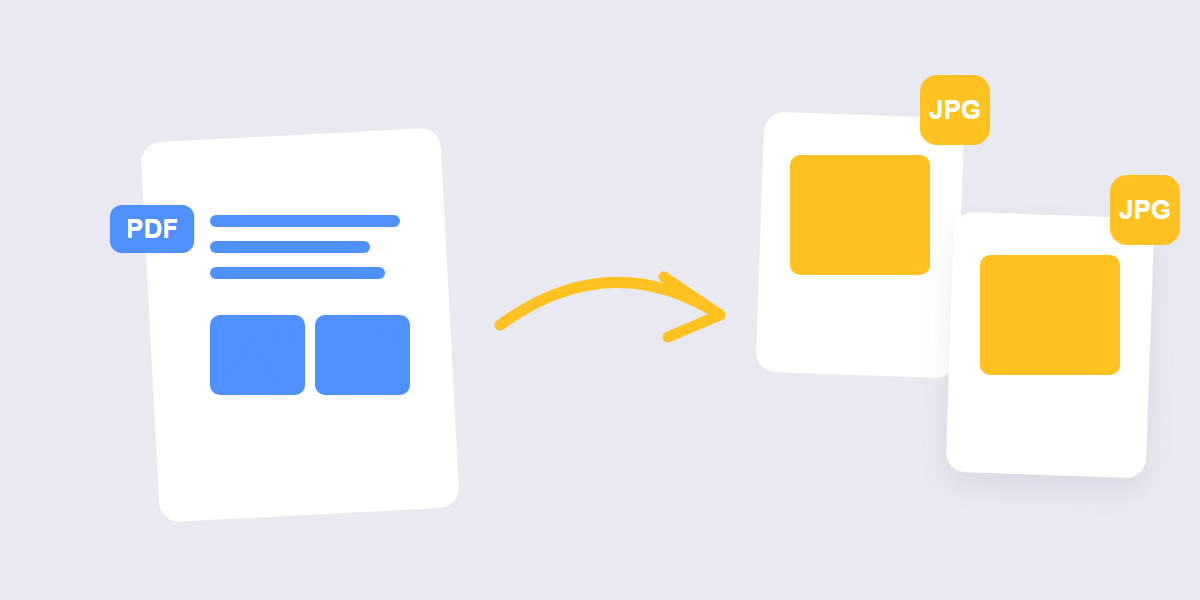
Quick answer: open a free PDF-to-JPG converter in your browser, drop your file in, choose the pages and quality, and download â each page becomes a JPG image. For text-heavy pages, PNG output is sharper; for photos and sharing, JPG at 90%+ quality is the right pick.
Converting a PDF to JPG turns every page into a flat image â which is exactly what you want for previews, social posts, slides and chat sharing, and exactly what you don’t want if someone needs to edit the text later. This guide covers the conversion, the quality settings that matter, and when JPG is the wrong choice.
How to convert PDF to JPG step by step
- Open the converter. Go to the free PDF to Image tool and drop your PDF in â batch files are fine, and everything runs locally in your browser.
- Choose pages and format. Convert all pages or just the ones you need, and pick JPG as the output. PNG is usually available too â see the comparison below.
- Set the quality. Higher quality means larger files; 90%+ keeps text crisp if the images will be zoomed or printed.
- Convert and download. You get one image per page, in order, ready to use.
Because the conversion runs in your browser, a 20-page document converts in seconds and your file never touches a server â the whole operation is private by default.
Quality settings that actually matter
Two settings decide whether your JPGs look sharp or mushy:
| Setting | What it controls | Recommendation |
|---|---|---|
| Quality level | How much detail the JPG keeps | 90%+ for text and print; 75â85% is fine for previews |
| Output format | JPG (small) vs PNG (sharp edges) | PNG for text-heavy pages, JPG for photos |
The resolution of your JPG comes from the PDF itself â a vector-based PDF converts sharply at any size, while a scanned PDF is capped at its scan resolution. Converting can’t add detail that isn’t in the source; if the scan was blurry, the JPG will be too.
JPG or PNG for your pages?
JPG wins for photos and anything being shared â smaller files, universal support, quality 90%+ is visually identical for screen use. PNG wins for text-heavy pages â it’s lossless, so character edges stay razor sharp instead of picking up JPG’s slight fuzz around letters.
The practical rule: converting a designed brochure or photo portfolio? JPG. Converting a typed contract or report where recipients might zoom in? PNG. Our JPG vs PNG vs WebP comparison has the full decision table with measured file sizes.
Conversion mistakes to avoid
- Converting at low quality, then re-converting. Every JPG re-save compounds the damage. Convert once at the quality you need and keep that file.
- Expecting editable text. A JPG is a picture â the words in it can’t be selected or edited. If editing is the goal, use PDF to Word instead.
- Forgetting page order. Images come out in page order; if you rearrange them in a folder later, the sort can scramble. Download and use them in the order delivered, or rename with number prefixes.
And if you need the reverse job â images combined into a PDF â the Image to PDF tool does exactly that in one pass.
FAQ
How do I convert a PDF to JPG for free?
Use a free browser-based converter like the PDF to Image tool: drop your PDF, pick JPG, set quality, and download one image per page. No signup, no watermark, and the file is processed on your own device.
Does converting PDF to JPG reduce quality?
The JPG format applies light compression, so at quality 90%+ the difference is invisible on screen. The bigger factor is your source: a vector PDF converts sharply, while a low-resolution scan produces a low-resolution JPG no matter the settings.
Why did my text become blurry in the JPG?
JPG compression slightly softens sharp edges â text suffers first. Convert those pages to PNG instead (lossless), or raise the JPG quality above 90%. Text-heavy documents are the classic PNG use case.
Can I convert only specific pages of my PDF?
Yes â the converter lets you pick pages before converting, so a 50-page PDF can give you just pages 4, 9 and 17 as images. No need to split the file first.
How do I convert PDF to JPG on my phone?
The same browser-based tool works on mobile: open it in your phone’s browser, pick the PDF from your storage, and download the JPGs to your photos. Nothing to install, and the conversion runs on your device.
Is converting a PDF to JPG safe for confidential documents?
With a browser-based converter, yes â the file is processed locally and never uploaded, so confidential content stays on your device. Avoid upload-based converters for sensitive documents, or verify their deletion policy first.
